|
Case Report
Callus-related supraclavicular neuropathy after a pediatric clavicle fracture
1 Children’s Health Ireland (CHI) at Crumlin Hospital, Medical Student, School of Medicine, Trinity College, Dublin, Ireland
2 Children’s Health Ireland (CHI) at Crumlin Hospital, Pediatric Orthopaedic Fellow, Orthopaedic Department, CHI at Crumlin, Dublin, Ireland
3 Children’s Health Ireland (CHI) at Crumlin Hospital, Pediatric Orthopaedic Consultant, Orthopaedic Department, CHI at Crumlin, Dublin, Ireland
Address correspondence to:
Joseph Rauca
Trinity College Dublin, The University of Dublin, College Green, Dublin 2,
Ireland
Message to Corresponding Author
Article ID: 100031Z19JR2026
Access full text article on other devices

Access PDF of article on other devices

How to cite this article
Rauca J, Boughton OR, O’Toole P. Callus-related supraclavicular neuropathy after a pediatric clavicle fracture. J Case Rep Images Pediatr 2026;8(2):1–6.ABSTRACT
Introduction: This report highlights the rare occurrence of a callus-related supraclavicular nerve neuropathy after clavicle fracture in a 9-year-old boy, presenting with hypoesthesia and dysesthesia over the clavicle and infraclavicular region. A detailed literature search revealed no such case previously described in a child, making this a unique incident.
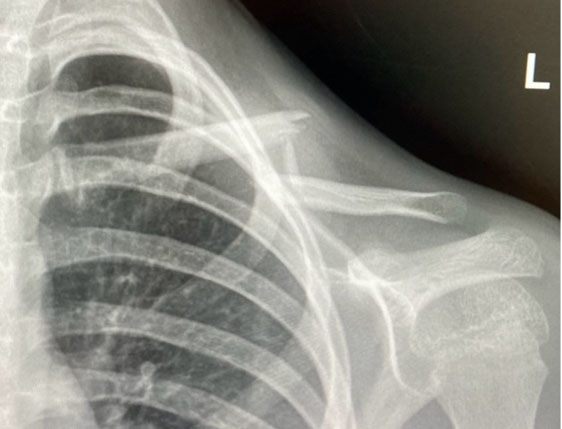
Case Report: The young boy sustained a closed, comminuted, left clavicle fracture from a significant fall while playing on a school astroturf. On examination, only a bump was noted. There was clear documentation of normal sensation and no other neurovascular damage. The patient was initially managed with oral analgesics and a sling support. The 3-week review revealed an adequate callus formed around the fracture. However, the patient still reported a lot of tenderness at the site of injury and experienced paresthesia and dysesthesia in the distribution of the supraclavicular nerve, which had developed in the three weeks leading up to this review. He was further managed with an arm sling for an additional three weeks and was given pendulum exercises to do. A review of the patient four weeks later revealed that the numbness had fully resolved about 1-month after its onset. The patient went on to fully heal and was discharged from the clinic.
Conclusion: Supraclavicular nerve neuropathies with a callus-related etiology are of very infrequent incidence. Callus-related supraclavicular neuropathies can be characterized by a delayed presentation over weeks to months of tenderness or sensory changes in the regions supplied by the nerve.
Keywords: Callus, Clavicle fracture, Paresthesia, Supraclavicular neuropathy
SUPPORTING INFORMATION
Author Contributions
Joseph Rauca - Conception of the work, Design of the work, Analysis of data, Drafting the work, Final approval of the version to be published, Agree to be accountable for all aspects of the work in ensuring that questions related to the accuracy or integrity of any part of the work are appropriately investigated and resolved.
Oliver Richard Boughton - Conception of the work, Design of the work, Revising the work critically for important intellectual content, Final approval of the version to be published, Agree to be accountable for all aspects of the work in ensuring that questions related to the accuracy or integrity of any part of the work are appropriately investigated and resolved.
Patrick O’Toole - Conception of the work, Design of the work, Acquisition of data, Revising the work critically for important intellectual content, Final approval of the version to be published, Agree to be accountable for all aspects of the work in ensuring that questions related to the accuracy or integrity of any part of the work are appropriately investigated and resolved.
Guaranter of SubmissionThe corresponding author is the guarantor of submission.
Source of SupportNone
Consent StatementWritten informed consent was obtained from the patient for publication of this article.
Data AvailabilityAll relevant data are within the paper and its Supporting Information files.
Conflict of InterestAuthors declare no conflict of interest.
Copyright© 2026 Joseph Rauca et al. This article is distributed under the terms of Creative Commons Attribution License which permits unrestricted use, distribution and reproduction in any medium provided the original author(s) and original publisher are properly credited. Please see the copyright policy on the journal website for more information.