|
Case Report
Cannabinoid hyperemesis syndrome versus hyperemesis gravidarum in adolescent patients: A diagnostic challenge
1 MD, Pediatric Resident, Pediatric Department at John H. Stroger Hospital of Cook County, 1969 W Ogden Ave, Chicago, IL 60612, USA
2 MBBS, Pediatric Resident, Pediatric Department at John H. Stroger Hospital of Cook County, 1969 W Ogden Ave, Chicago, IL 60612, USA
3 DO, Pediatric Attending, Pediatric Department at John H. Stroger Hospital of Cook County, 1969 W Ogden Ave, Chicago, IL 60612, USA
Address correspondence to:
Bunmi Adelowo
Pediatric Resident at John H. Stroger Hospital of Cook County, 1969 W Ogden Ave, Chicago, IL 60612,
USA
Message to Corresponding Author
Article ID: 100032Z19BA2026
Access full text article on other devices

Access PDF of article on other devices


How to cite this article
Adelowo B, Montgomery T, Murray S, So A. Cannabinoid hyperemesis syndrome versus hyperemesis gravidarum in adolescent patients: A diagnostic challenge. J Case Rep Images Pediatr 2026;8(2):7–10.ABSTRACT
Introduction: Nausea and vomiting are common in early pregnancy and are often attributed to hyperemesis gravidarum (HG). However, with increasing cannabis use among women of reproductive age, cannabinoid hyperemesis syndrome (CHS) has emerged as an important differential diagnosis. The clinical overlap between these conditions is demonstrated in this case with the aim to bring attention to the diagnostic challenge, especially in the pediatric population.
Case Report: A 15-year-old gravida 1 para 0 woman at 6 weeks’ gestation presented with persistent nausea, repeated vomiting, abdominal pain, and dehydration, without any known symptomatic relief. The patient was initially diagnosed with HG, but further history was notable for daily cannabis use for the past one year. Despite supportive management and antiemetic therapy, symptoms persisted until pregnancy termination and cessation of cannabis usage. The patient was later readmitted with similar symptoms after restarting cannabis usage.
Conclusion: Cannabinoid hyperemesis syndrome closely mimics HG and may lead to diagnostic confusion during pregnancy. Detailed substance use history, awareness of CHS features, and prompt cannabis cessation are essential for appropriate management.
Keywords: Cannabinoid hyperemesis syndrome, Cannabis, Hyperemesis gravidarum, Pregnancy, Vomiting
Introduction
The spectrum of nausea and vomiting affects an average of 70% of pregnancies [1]. On the severe end of the spectrum of symptoms is hyperemesis gravidarum (HG). Hyperemesis gravidarum is a diagnosis of exclusion that is often associated with significant weight loss, dehydration, and metabolic disturbances and requires medical intervention [2]. There is a plethora of differentials for nausea and vomiting in women of reproductive age and no specific diagnostic test for HG. This represents a diagnostic challenge for clinicians.
One differential of crucial importance is cannabis hyperemesis syndrome (CHS). Cannabis hyperemesis syndrome, like HG, does not have a standard diagnostic test and is characterized by cyclic vomiting, nausea, and abdominal pain. In most cases, prolonged or frequent hot bathing relieves symptoms [3]. Although they present with similar symptoms, the management of these conditions varies significantly. For CHS, typical antiemetics are ineffective, although effective for HG.
Cannabis hyperemesis syndrome should be considered in pregnant women with nausea and vomiting, particularly pregnant adolescent women, due to the intersection of populations affected. In the United States, use of cannabis is most common among young adults ages 18–25 [4]. This age group overlaps with the age group that accounts for 61.5% per 1000 live births (women aged 20–25) [5] and with the maternal age group in which there is increased risk of HG (under 20 years) [6].
The clinical overlap between these conditions is demonstrated in this case with the aim of bringing attention to the diagnostic challenge. We also hope to bring awareness to the fact that lack of consideration for CHS in pregnant women presenting with severe nausea and vomiting can result in misdiagnosis, mismanagement, and potential maternal and fetal adverse outcomes.
Case Report
A 15-year-old gravida 1 para 0 African American woman at six weeks of gestation presented to the emergency department with persistent nausea, repeated vomiting, and abdominal pain for five days, and inability to tolerate oral intake. She denied fevers or diarrhea. The patient identified her pregnancy as unwanted and requested a termination. On examination, the patient was afebrile, normotensive, and appeared dehydrated.
Laboratory evaluation revealed serum sodium of 133 mEq/L, potassium 3.8 mEq/L, normal anion gap metabolic acidosis (NAGMA), high urine specific gravity, and ketonuria. Transabdominal ultrasonography confirmed a viable intrauterine pregnancy. The initial diagnosis was HG. She was treated with intravenous fluids, and antiemetics (including ondansetron and metoclopramide). Despite 24 hours of therapy, vomiting persisted without noticeable improvement.
Upon further questioning, patient disclosed daily cannabis use for one year, which she claimed to have stopped one week prior to presentation. Given her history of chronic cannabis use, a diagnosis of CHS was suspected. Lorazepam, Haldol, diphenhydramine, and topical capsaicin cream were administered to the patient, with mild relief of symptoms. The patient had a dilation and curettage (D&C) done on day 5 of admission, after which her symptoms resolved. The patient received counseling regarding cannabis-related risks and was advised to discontinue use. At the one-month follow-up, the patient’s symptoms had completely resolved. However, one year later, she was readmitted with a similar clinical presentation and reported that she had resumed cannabis use. She was not pregnant during this subsequent episode, further supporting cannabinoid hyperemesis syndrome (CHS) as the underlying diagnosis for both presentations.
Discussion
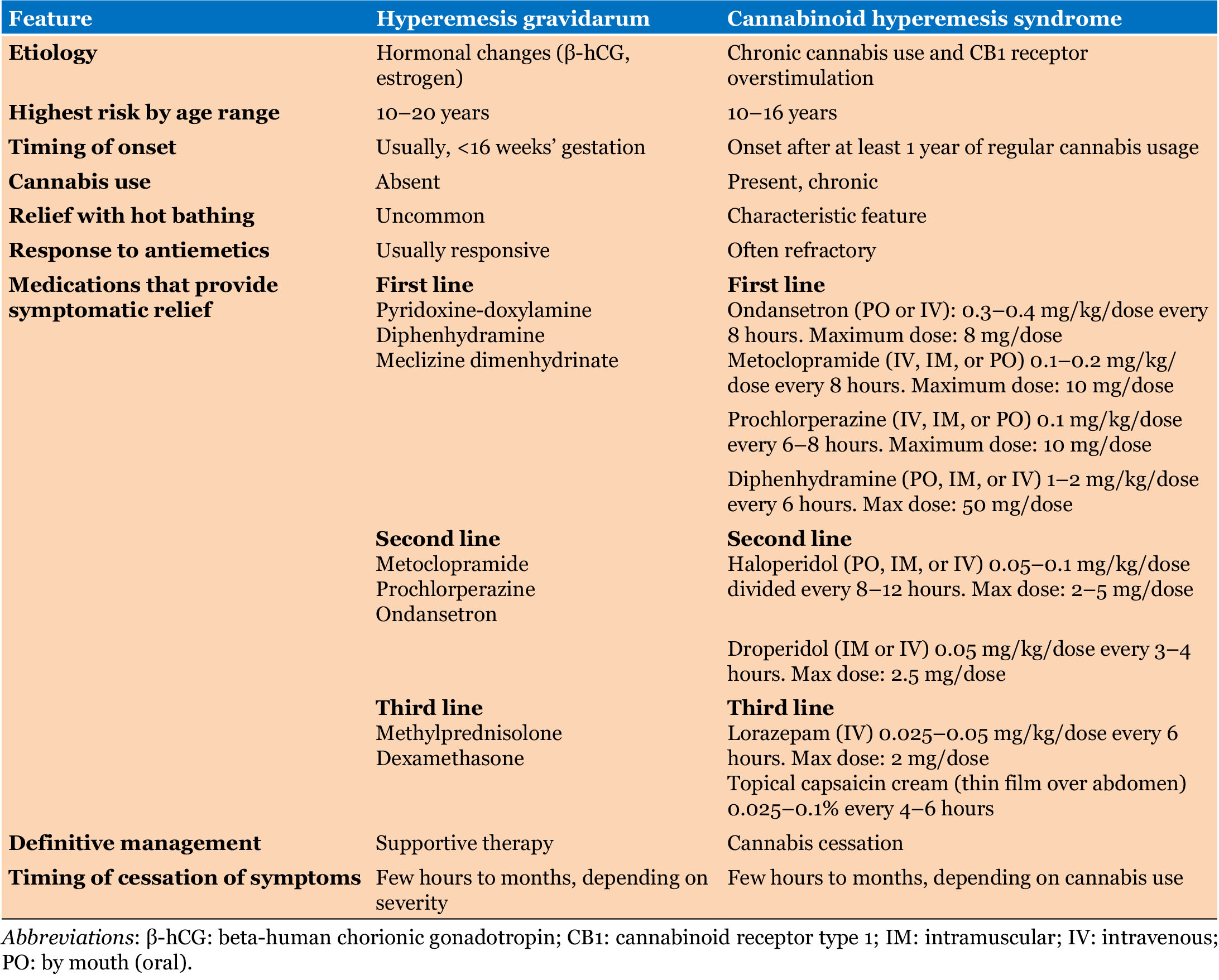
Cannabinoid hyperemesis syndrome has emerged as a major cause of intractable nausea and vomiting in adolescent patients, especially due to the rise in cannabis use among this population of patients. It is estimated that 42% of adolescents use cannabis and these population of patients are more likely to develop CHS [7]. The prevalence, awareness, and diagnosis of CHS have increased in the last decade with legalization of cannabis and increases in delta-9-tetrahydrocannabinol (THC) concentration in cannabis products. This case underscores the diagnostic overlap between CHS and HG in pregnancy, especially in the pediatric population. Although both conditions reflect severe vomiting, dehydration, and electrolyte imbalance, some distinctions are notable. The distinguishing features of CHS and hyperemesis gravidarum are compared in Table 1.
Cannabis use in pregnancy is likely underreported, so there are limited case reports of CHS among pregnant adolescents. One patient notably presented with recurrent nausea, vomiting, and abdominal pain as a chronic cannabis user at weeks 16 and 18 with improvement of symptoms after a hot bath [8]. Early presentation at five weeks is also noted in the literature, similar to our patient’s admission at six weeks of gestational age. Diagnostic confusion can occur as CHS has many overlapping features with HG; however, cessation of cannabis results in resolution of the vomiting episodes [8]. A recent review indicates that 14% of patients self-report cannabis using as a therapy for HG to alleviate symptoms and improve pregnancy weight gain [9]. The risk factors for severe HG include younger age, Black/Asian/mixed ethnicity. The risk factors for CHS include ethnic minority groups, poor socioeconomic background, and adverse childhood events. However, important distinctive risk factors for CHS are heavy cannabis use (daily or several days per week, for more than a year), and cannabis use before age 16 as in our patient [9]. Due to this overlap in symptoms, incidence and prevalence, a misdiagnosis of CHS in the pregnant adolescent could lead to delayed treatment and prolonged distress.
Despite the overlapping similarities that exist between HG and CHS, treatment is different. In a large population based study, 34% of patients admitted for CHS had failed first line antiemetic therapy [10]. Cannabis products have been noted to have dramatically increased potency with higher THC components in recent years [11]. With prolonged duration of use, cannabis may have a biphasic mechanism of action, where it has antiemetic effects at lower or less frequent dosing but is proemetic at higher or more sustained doses [12]. The emetogenic effect of cannabis, particularly in CHS derives from chronic, excessive stimulation of endocannabinoid receptors (CB1) in the brain and gut. This overloading of CB1 paradoxically overrides cannabinoids’ usual antiemetic properties by disrupting G-protein pathways that control vomiting and disrupts thermoregulation; hence, patients seem to get relief from hot baths [13]. An overstimulation of CB1 also causes a disruption in the gut–brain axis, resulting in gut dysmotility and increased visceral pain perception [13].
Conclusion
Cannabinoid hyperemesis syndrome should be considered in pregnant adolescents with persistent or refractory vomiting, particularly those with a history of cannabis use. Distinguishing CHS from hyperemesis gravidarum is essential to prevent misdiagnosis, avoid unnecessary interventions, and improve outcomes. Clinicians should maintain a high index of suspicion and obtain a detailed substance use history as part of the evaluation of nausea and vomiting in pregnancy.
REFERENCE
1.
Jansen LAW, Shaw V, Grooten IJ, Koot MH, Dean CR, Painter RC. Diagnosis and treatment of hyperemesis gravidarum. CMAJ 2024;196(14):E477–85. [CrossRef]
[Pubmed]

2.
Vadakekut ES, Mahdy H. Hyperemesis gravidarum. In: StatPearls. Treasure Island (FL): StatPearls Publishing; 2026.
[Pubmed]
3.
Cue L, Chu F, Cascella M. Cannabinoid hyperemesis syndrome. In: StatPearls. Treasure Island (FL): StatPearls Publishing; 2026.
[Pubmed]
4.
Substance Abuse and Mental Health Services Administration. 2021 NSDUH annual national report. Rockville, MD: Substance Abuse and Mental Health Services Administration; 2023. [Available at: https://www.samhsa.gov/newsroom/press-announcements/20250728/samhsa-releases-annual-national-survey-on-drug-use-and-health]
5.
Osterman MJK, Hamilton BE, Martin JA, Driscoll AK, Valenzuela CP. Births: Final data for 2022. Natl Vital Stat Rep 2024;73(2):1–56.
[Pubmed]
6.
Munawaroh S, Pratiwi LL, Soetrisno S. Hyperemesis gravidarum and maternal age under 20 years: A cross sectional study. PLACENTUM Jurnal Kesehatan dan Aplikasinya 2022;10(3):163–8. [CrossRef]
7.
Jiménez-Castillo RA, Arumugam S, Remes-Troche JM, Venkatesan T. Cannabinoid hyperemesis syndrome: A review. Rev Gastroenterol Mex (Engl Ed) 2025;90(2):214–26. [CrossRef]
[Pubmed]
8.
Hanley S, Imcha M, Mohamad MM. Cannabinoid hyperemesis syndrome in pregnancy: A case series and review. Obstet Med 2024;18(4):264–71. [CrossRef]
[Pubmed]
9.
First OK, MacGibbon KW, Cahill CM, Cooper ZD, Gelberg L, Cortessis VK, et al. Patterns of use and self-reported effectiveness of cannabis for hyperemesis gravidarum. Geburtshilfe Frauenheilkd 2022;82(5):517–27. [CrossRef]
[Pubmed]
10.
Fiaschi L, Nelson-Piercy C, Deb S, King R, Tata LJ. Clinical management of nausea and vomiting in pregnancy and hyperemesis gravidarum across primary and secondary care: A population-based study. BJOG 2019;126(10):1201–11. [CrossRef]
[Pubmed]
11.
Becerra LS, Gould E, Roble A, Nguyen RM, Okemkpa C, Ceasar RC, et al. 802 Nausea and vomiting during pregnancy, cannabis use, and health implications among an international Latina subgroup. American Journal of Obstetrics & Gynecology 2024;230(1 Suppl):S427. [CrossRef]
12.
Hasler WL, Alshaarawy O, Venkatesan T. Cannabis use patterns and association with hyperemesis: A comprehensive review. Neurogastroenterol Motil 2025;37(3):e14895. [CrossRef]
[Pubmed]
13.
Venkatesan T, Tarbell S, Adams K, McKanry J, Barribeau T, Beckmann K, et al. A survey of emergency department use in patients with cyclic vomiting syndrome. BMC Emerg Med 2010;10:4. [CrossRef]
[Pubmed]
SUPPORTING INFORMATION
Author Contributions
Bunmi Adelowo - Conception of the work, Design of the work, Acquisition of data, Analysis of data, Drafting the work, Revising the work critically for important intellectual content, Final approval of the version to be published, Agree to be accountable for all aspects of the work in ensuring that questions related to the accuracy or integrity of any part of the work are appropriately investigated and resolved.
Tanya Montgomery - Conception of the work, Design of the work, Acquisition of data, Analysis of data, Drafting the work, Revising the work critically for important intellectual content, Final approval of the version to be published, Agree to be accountable for all aspects of the work in ensuring that questions related to the accuracy or integrity of any part of the work are appropriately investigated and resolved.
Saraya Murray - Conception of the work, Design of the work, Acquisition of data, Analysis of data, Drafting the work, Revising the work critically for important intellectual content, Final approval of the version to be published, Agree to be accountable for all aspects of the work in ensuring that questions related to the accuracy or integrity of any part of the work are appropriately investigated and resolved.
Alina So - Conception of the work, Design of the work, Acquisition of data, Analysis of data, Drafting the work, Revising the work critically for important intellectual content, Final approval of the version to be published, Agree to be accountable for all aspects of the work in ensuring that questions related to the accuracy or integrity of any part of the work are appropriately investigated and resolved.
Guaranter of SubmissionDr. Alina So is the Guarantor of Submission.
Source of SupportNone
Consent StatementWritten informed consent was obtained from the patient for publication of this article.
Data AvailabilityAll relevant data are within the paper and its Supporting Information files.
Conflict of InterestAuthors declare no conflict of interest.
Copyright© 2026 Bunmi Adelowo et al. This article is distributed under the terms of Creative Commons Attribution License which permits unrestricted use, distribution and reproduction in any medium provided the original author(s) and original publisher are properly credited. Please see the copyright policy on the journal website for more information.